| site search by freefind |
- Home
- Scripture Snapshots
- Genesis
[If you purchase anything on this site, I may make a commission. Disclosure Policy]
Genesis Is The Foundational Book
Of The Bible
By Glenn Davis
Genesis is the first book in the Bible, although it may not have been the first book written. Some scholars believe that Job was written first. In any case, it is an ancient book named after the Greek word for “origins”: Genesis. The Hebrews called this book “In The Beginning” because they named books after the first few words. Either way, it is a great name, as it reveals the origin of the universe and many firsts in human history, including the first:
- Man and woman
- Marriage
- Sin
- Promise of Salvation
- Farmer, musician, architect
- Child and parents
- Murder/crime
- Justice
- Curse and Blessing
- Laws
- Language division
- And so much more.
Sitemap -
Free Water Of The Word Newsletter -
Statement Of Faith -
Donate
Follow us on social media for daily Scripture comments and more at MeWe, Facebook or YouTube.

Foundational Book
The Book of Genesis is the Bible’s foundational book. It answers most of the questions that have plagued mankind for millennia: Who am I? Where do I come from? Why is there evil in the world? Do I have purpose and, if so, what is it? And, of course, does God exist, and what kind of God is He? Every important Christian doctrine finds its roots in this book. Four of the seven major covenants God made with mankind [Edenic, Adamic, Noahic, and Abrahamic] appear in its pages.
Historical Timeline
The Book of Genesis begins with the creation of the world in six literal days and ends with the death of Joseph, 2,369 years later. About one-third of human history to date happened during this timeline. Anyone who wants to understand what is happening in the rest of the Bible and even in our world today needs to understand Genesis.
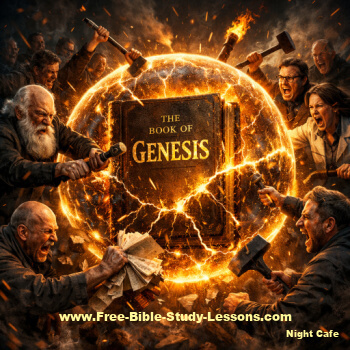
Because of this, the Book of Genesis is the most attacked book in the Bible. Critics know that if they can destroy this book, they can destroy Christianity. We expect those outside of Christianity to attempt to discredit this book; however, even those who claim to be inside the Christian fold have undermined its credibility by claiming sections are myth, legend or allegory or by trying to insert heathen origin theories into the straightforward creation account. They have twisted and mangled holy Scripture in their efforts to compromise with the world. They basically call God, the only Eyewitness, and the Holy Spirit of Truth a liar, as if they somehow know better than God what happened. That is very dangerous territory. We need to carefully think through the implications of what we say we believe, not only here but everywhere.
Author
Moses wrote this book probably between 1532 BC, when the Ten Commandments were given, and 1494 BC, when he died. With the other four books of the Pentateuch, Moses was an eyewitness to everything except the last chapter of Deuteronomy, which records his death. That part was probably written by Joshua as an epilogue. For Genesis, Moses, under divine inspiration, was most likely an editor who compiled about eleven family documents, including histories, diaries, and oral traditions. Many places in the Old and New Testaments acknowledge Moses as the author. Jesus Himself believed Moses was responsible for this book. The Holy Spirit was the Master Hand behind it all, ensuring the record's accuracy, including the creation of the world, which had no human witness for the first five days.
Divisions Of Genesis
Genesis is divided into eleven sections plus an introduction; each section begins with the words: These are the generations of…[KJV], or This is an account of… [NIV] or something similar, depending on how the phrase is translated. What follows explains the results of what came from the “generations of.” The sections are:
Introduction - Gen. 1:1-2:3
Section 1 - Generations Of The Heavens And The Earth - Gen. 2:4-4:26
Section 2 - Generations Of Adam - Gen. 5:1-6:8
Section 3 - Generations Of Noah - Gen. 6:9-9:29
Section 4 - Generations Of Shem, Japheth And Ham - Gen. 10:1-11:9
Section 5 - Generations Of Shem - Gen. 11:10-26
Section 6 - Generations Of Terah - Gen. 11:27-25:11
Section 7 - Generations Of Ishmael - Gen. 25:12-18
Section 8 - Generations Of Isaac - Gen. 25:19-35:29
Section 9 - Generations Of Esau - Gen. 36:1-8
Section 10 - Generations Of Esau Part Two - Gen. 36:9-37:1
Section 11 - Generations Of Jacob - Gen. 37:2-50:26
Two Key Teachings
As we said above, all the doctrines of the Bible can be found in “seed” form in the Book of Genesis. Two very important ones are Genesis 3:15 and Genesis 15:6.
And I will put enmity between you and the woman, and between your offspring and hers; he will crush your head, and you will strike his heel. Gen. 3:15, NIV
Here we see the beginning of the conflict between God and Satan, which would rage throughout the Old Testament. God promised a “seed,” or offspring, would come who would destroy satan and all his works. This Seed, Jesus, as we learn in the New Testament, would crush Satan, but it would not be without cost because His heel would be crushed [at the cross]. The fact that He would be the Seed of the woman also indicates the virgin birth. This has well been called the seed verse of the Bible, as it encapsulates the entire story of Redemption.
Abram believed the Lord, and He credited to him as righteousness. Gen. 15:6, NIV
In this verse, we see the foundation of the teaching of justification by faith. Every religion in the world, including humanism, is legalistic. They try to produce salvation by works. Christianity says that works can never be enough to please God. Right standing before God can only come by faith. In the Old Testament, the people needed faith in the coming Redeemer and what He would accomplish. In the New Testament, we have faith in what our Redeemer, Jesus Christ, did on the cross by shedding His blood and rising from the dead. It is the same faith in the same act.
References
The Genesis Account, Jonathan D. Sarfati
The Reformation Study Bible, ESV, General Editor R.S. Sproul
Survey Of The Bible, Willian Hendriksen
Book Of Genesis
General information
Book Of Genesis
Articles By Scriptural Reference
Under Construction: Genesis articles will be moved here as they are reviewed and updated.

Glenn Davis is a Christian author and Bible teacher whose work draws on more than 40 years of study, writing, and teaching in local churches. He has written 700+ articles, created five Bible courses, published three books, and shared 300+ Bible videos on YouTube. Readers can find his books on Amazon, follow his teaching on YouTube or visit Glenn Davis Books. Away from the keyboard, he enjoys time with family, reading, walking, and board or card games.
Follow us on social media for daily Scripture comments and more at MeWe, Facebook or YouTube.
Sitemap -
Newsletter -
Statement Of Faith -
Donate
Sign up for our free monthly newsletter or take one of our free Bible Study courses.
Please note: We no longer have the commenting feature [maybe again in the future]. Joshua Institute students who have questions or comments on their courses can use the contact button and mention the course name and lesson number in the email. Thank you. Glenn



Privacy - Disclosure
"Feed Yourself" is a trademark of Glenn Davis. All rights reserved.
Copyright © 2004–