| site search by freefind |
- Home
- Christian Social Theory
- Free Market
- Labour Unions
[If you purchase anything on this site, I may make a commission. Disclosure Policy]
Labour Union Principles:
Supported By Scripture Or In Violation Of It?
By Glenn Davis
Labour unions are part of our modern life. Are they legitimate? What is the Christian response? Labour unions developed long after the Bible was written; however, God's Word is remarkable. If you go into a lawyer's office, you will probably see shelves lined with law books, which represent a small fraction of humanistic law. God, in the 66 books that we call the Bible, placed the foundation of all the laws that would be needed until the return of Christ. In fact, man is not allowed to attempt to create law, only to apply God's law in various situations. So, what does God's law have to say about the principles on which labour unions are based?
God Is A Worker
We need to start with work. God is a worker. He designed us to be workers.
"Six days shalt thou labour, and do all thy work...For in six days the LORD made heaven and earth, the sea, and all that in them is, and rested the seventh day: wherefore the LORD blessed the sabbath day, and hallowed it." Ex, 20:9, 11
"He also that is slothful in his work is brother to him that is a great waster." Pr. 18:9
"Whatsoever thy hand findeth to do, do it with thy might; for there is no work, nor device, nor knowledge, nor wisdom, in the grave, whither thou goest." Ecc. 9:10
It is God's desire that we all work. Labour unions have come into being to organize workers to achieve certain goals. Some companies have abused their employees, and labour unions have stood up for the helpless. In a sinful world, there will always be abuses, but the question is: How does God expect us to handle abuses? Are labour unions the correct response? Whose responsibility is it to handle workplace abuses? We will answer these questions Scripturally.

Sitemap -
Newsletter -
Statement Of Faith -
Donate
Follow us on social media for daily Scripture comments and more at MeWe, Facebook or YouTube.
How Does God Expect Us To Handle Abuses In The Workplace?
We must distinguish between real abuse and differences of opinion. Real abuse involves things like sexual harassment, unsafe working conditions, force or violence, violating agreements, etc. In short, it is Biblically-defined criminal activity against employees [or employers]. Differences of opinion include things like hours of work, pay rate, vacation time, promotions, benefits, etc., unless these things have been promised, in which case it becomes an agreement violation.
How Do We Handle Real Abuse?

We can report the abuse to the police or those in authority. In some cases, it is also possible to bring a civil lawsuit.
"And I charged your judges at that time, saying, Hear the causes between your brethren, and judge righteously between every man and his brother, and the stranger that is with him." Deut. 1:16
"For this is a heinous crime; yea, it is an iniquity to be punished by the judges." Job 31:11
In God's system, a Godly society handles real abuses through the court
system according to Biblical Law. The Biblical justice system is meant to
protect both employers and employees from evil actions. Now we
know we do not live in Godly countries. We cannot depend on the courts
to give fair decisions. What are we to do?
Since we are dealing with Biblically-defined crimes, we have to see if the court system is an option. For example, sexual harassment may be able to be handled in court, while unsafe job conditions may not be. We have to assess the individual situation.
If both the employer and the employee are Christians, both should study the Word of God about their OWN responsibilities [not the other person's]. If they cannot come to an agreement, then the matter is to be brought before a church council/arbitrator committed to Biblical Law, whom both can trust. They need to be willing to live with the decision.
"Then both the men, between whom the controversy is, shall stand before the LORD, before the priests and the judges, which shall be in those days;" Deut. 19:17
In cases of real abuse, we have to look at all legitimate options: the courts, the church, resigning, or going to the labour union. In a society where the courts cannot be depended on to provide God's justice, a labour union may offer some protection, although it often does not operate on Biblical principles any more than the courts do. As with a divorce case, a Christian must first determine that a legitimate Biblical offence has occurred. This needs to be confirmed by unbiased Godly counsellors familiar with Biblical Law. After it has been confirmed, the Christian then considers what is the best instrument in an unGodly society to achieve justice or as close to it as possible.
Note: It is the duty of the Christian to stand up for and help the weak who are being abused or taken advantage of. This may be against employers or other employees. However, in wisdom, we must make sure we are truly understanding the situation. We must get the whole story, seek the truth, and not be emotionally manipulated into supporting someone who, perhaps, is only telling part of the situation.
How Do We Handle
Differences Of Opinion?
What if we don't think we are being paid enough? What if we don't like our work hours? What if we want more vacation time? What if we want more benefits? What about all these and other things?
"Servants, be subject to your masters with all fear; not only to the good and gentle, but also to the froward." 1 Peter 2:18
Jesus told a very instructive story on these issues. One which many people wish He had forgotten!
For the kingdom of heaven is like unto a man that is a householder, which went out early in the morning to hire labourers into his vineyard. And when he had agreed with the labourers for a penny a day, he sent them into his vineyard. And he went out about the third hour, and saw others standing idle in the marketplace, and said unto them, Go ye also into the vineyard, and whatsoever is right I will give you. And they went their way. Again he went out about the sixth and ninth hour, and did likewise. And about the eleventh hour he went out, and found others standing idle, and saith unto them, Why stand ye here all the day idle? They say unto him, Because no man hath hired us. He saith unto them, Go ye also into the vineyard; and whatsoever is right, that shall ye receive.
So when even was come, the lord of the vineyard saith unto his steward, Call the labourers, and give them their hire, beginning from the last unto the first. And when they came that were hired about the eleventh hour, they received every man a penny. But when the first came, they supposed that they should have received more; and they likewise received every man a penny. And when they had received it, they murmured against the goodman of the house, Saying, These last have wrought but one hour, and thou hast made them equal unto us, which have borne the burden and heat of the day. But he answered one of them, and said, Friend, I do thee no wrong: didst not thou agree with me for a penny? Take that thine is, and go thy way: I will give unto this last, even as unto thee. Is it not lawful for me to do what I will with mine own? Is thine eye evil, because I am good? Matt. 20:1-15
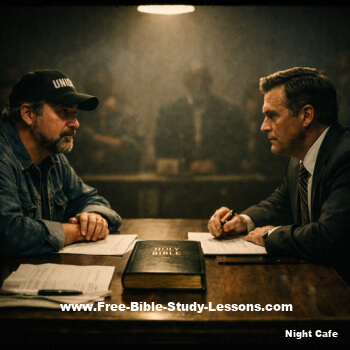
The employer reached a mutually agreeable contract with his first employees. They all agreed that this was a fair price for the day's work, and then they went to work. The employer did not force the people to work for him. The employees did not have to agree to his offer. But both sides agreed. The contract was established. The employer would provide the agreed-on wage, and the employee would provide the agreed-on labour.
The employer hired other employees during the day. He made no promise of what the wage would be, but the employees were willing to work under those conditions. They did not have to, but they trusted that it would be worth their time.
At the end of the day, the employer gave everyone the same wage. Those hired first - like good humanists - thought this was unfair. The employer pointed out that he had faithfully fulfilled his contract to them - which they had both agreed was fair - and they had no right to tell him how he would spend the rest of his money. As long as the contract to them was fulfilled, it was none of their business what he did to others.
Jesus makes plain that the employee has the right to whatever was promised in a mutually agreed-upon contract, but has no further rights on the employer's time, money, or property.
Mutually Agreeable Union Contracts
Neither the employer nor the employee is to try to force the other into a contract against their will. It must be freely entered into on both sides. If the employer forces the employee to work for wages and/or benefits below what they are willing to, then that is oppression by slavery. If the employee - often through labour unions - forces the employer to pay more in wages and/or benefits than he is willing to, then that is oppression by extortion. If there is no mutually agreeable contract, then the employees are free to seek other employers who more closely match their desires or even start their own businesses, and the employer is free to seek other employees who are willing to accept lower wages and/or benefits.

Unions may represent a group of employees and negotiate a contract with an employer to their mutual benefit. However, if the union uses tactics to try and force an employer to give more than he is willing to give, then we have a sinful, unBiblical, oppressive situation. No Christian should support such activity, which is actually criminal extortion.
This means that strikes are totally wrong. No Christians should ever vote for a strike for any reason. Any job action designed to hurt the employer's business or force him into a contract against his will is sin. If employees feel they cannot work under the conditions offered, they have the right to quit - all at once if they wish. However, they cannot complain if the employer finds other employees who are willing to work under his conditions.
The employer is in charge of his business as long as he is not violating a mutually agreed-upon contract or the limits of Biblical Law. This means that unions have no right to try to control any aspect of the employer's actions as long as they are not criminal or contract violations. The employer has the right to promote whomever he wishes regardless of seniority as long as that is not a term in the contract. If the employer wants to give someone a raise or a bonus above the contract wage, that is his right. As long as he is not paying anyone below the contract rate, there is no problem.
Employees and Unions often feel they have a right to their jobs. This is a misconception. A job is a position of mutual benefit. The employer desires the labour of the employee more than the money/benefits paid to the employee. The employee desires the money/benefits more than his time. If there is no contract, then either party has the right to end the relationship with proper notice [traditionally two weeks]. The employee can quit. The employer can end the job position or fill it with someone else. If there is a contract, both parties must live by its terms. When the contract ends, both parties are free to make their own decisions. No one has a lifetime right to a job. A job is only valid as long as it is mutually beneficial.
Unions And Their Members
Most - if not all labour Unions are closed shop unions. This means that in order to work for a given employer, a person must belong to a Union. Nowhere in the Bible is permission given for one person to force another person into any kind of relationship. Closed shop Unions are based on extortion, fear, and violence or the threat of violence - "You have to pay us, or we won't let you have a job!"
The only legitimate labour unions are voluntary associations which restrict their activities to protecting their members from real abuses and negotiating mutually beneficial contracts. They could also provide training, education, job placement, social activities, etc. for their members and/or families. This way, labour unions have to earn their membership. They have to convince workers that the benefits they provide are worth more than the dues they charge. If they fail to live up to their promises, then they lose members.
Are Unions Biblical?
Questions
Considering that closed-shop unions are a form of extortion, should Christians abstain from taking careers where union membership is a requirement?
Considering that closed-shop unions are a form of extortion, should Christians abstain from taking careers where union membership is a requirement?
I don’t write about my personal story on the website very often, as I want people to judge what I write by the Word of God. However, I will show where I am coming from so you can judge any personal bias I may have.
I have never been in a union, but it was not because of conviction. I started out working as a stockboy for a small non-union grocery store chain [5 stores]. I later moved to middle management. About 29 years ago, I moved to a unionized major grocery chain; however, I was hired into lower management just above the union requirement but not high enough to make any real decisions. So I've never had to make that decision myself.
As I said in my article, I believe closed-shop unions are unBiblical and involved in extortion of any unwilling members. However, we live in an unGodly society [because much of Western Christianity has rejected the Laws of God]. While we work, pray and teach for a return to a Godly society, we live under the system in which we have been placed. For example, I believe property tax is an unBiblical oppressive system; however I do not recommend people not paying it.
As far as our current situation, whether a Christian can belong to a labour union, I believe it is a matter of personal conscience before God, as long as they are not personally engaged in or support unGodly actions [for example, strikes]. I would look to Biblical examples such as Elijah, who stood outside the “system” and proclaimed God’s rule and justice, and Daniel, who worked within the system to provide Godly advice and direction while never compromising his integrity. God has different roles for different people, and we must not judge people harshly in different roles as long as they love God, obey His ways, and serve Him to the best of their ability.
I hope this doesn’t sound like I am avoiding your question. I wish things were always black and white. While we should never compromise the Word of God and the Kingship of Jesus Christ, sometimes actions fall into a “grey” zone, such as Rahab’s lie and Bonhoeffer’s participation in a plot against Hitler. Then we must make the best decision we can, keeping a clear conscience before God and keeping in mind what best honours Jesus Christ and expands His kingdom on earth.
Did the early Christian belong to unions?
Did the early Christian belong to unions?
Labour unions as we know them today did not exist then; however, trade guilds did, and they controlled the various trades. Christians in the early church often refused to join these guilds at great personal cost because the guilds' social commitments often required mandatory idol worship. We cannot participate in any activity which would require us to deny the Lord Jesus or violate His commands.
Readers Write
I think where we take different roads is where you stated, 'the extortion of any unwilling members"
The way unions operate, as long as you're a member, whether you are willing or not, you act as one. We take the position that being a member is an act against the employer. Like joining a gang. Perhaps you aren't the gang member who does physical harm, but you receive your share of the spoils at the end of the day.
If getting a job requires you to join the gang, then for the Christian that job should be off-limits.
I do not believe unwilling members are being extorted, but that they are benefiting handsomely from extortion against the employer.
As David says in Psalm 141:
"Do not let my heart incline to any evil,
to busy myself with wicked deeds
in company with men who work iniquity,
and let me not eat of their delicacies!"
Many folks in the Christian community acknowledge the wickedness of unions, but it's an unpopular position to say we shouldn't join them.
Marissa, USA

Glenn Davis is a Christian author and Bible teacher whose work draws on more than 40 years of study, writing, and teaching in local churches. He has written 700+ articles, created five Bible courses, published three books, and shared 300+ Bible videos on YouTube. Readers can find his books on Amazon, follow his teaching on YouTube or visit Glenn Davis Books. Away from the keyboard, he enjoys time with family, reading, walking, and board or card games.
Follow us on social media for daily Scripture comments and more at MeWe, Facebook or YouTube.
Sitemap -
Newsletter -
Statement Of Faith -
Donate
Sign up for our free monthly newsletter or take one of our free Bible Study courses.
Please note: We no longer have the commenting feature [maybe again in the future]. Joshua Institute students who have questions or comments on their courses can use the contact button and mention the course name and lesson number in the email. Thank you. Glenn

You might like these
Does The Bible Force A Woman To Marry Her Rapist?
A misunderstanind of Biblical Law has lead to the idea that the Bible teaches a woman must marry her rapist. The law actually is a protection for the woman.
Abortion: Murder Or Right?
How does the Bible view abortion? The Bible gives specific instructions and consequences.
God's Law Vs Man's Law
The conflict between God's Law Vs Man's Law is a conflict between ultimate authority: God or Man. Man has no authority to make law, only to apply God's law in specific situations.
Is The Law Of God Relevant Today?
God's Law is a revelatioin of His Holy Character and is as relevant today as when it was first given. Some aspedts of the law are kept in a different way, but they are still valid.
Jael: God's Assassin To Deliver His People
Jael became God's assassin and shows us some harsh principles of living in a sinful world.
Looking For Justice
We often equate spiritually with "church" activities, when God is looking for justice and integrity.
Capital Punishment Article Questioned
This is my response to a reader who questioned the artilce on capital punishment. What does the Bible really teach?
Does The Bible Allow Public Education?
We have become so accustomed to the public education of children that we fail to search the Scriptures to see if the Bible allows it.
Why Does God Allow Slavery In The Bible
Why does slavery in the Bible seem to be condoned rather than opposed? Should Christians be embarrassed by Bible slavery laws?
Christian Insanity
It is Christian insanity to think we can have the blessings of God while rejecting His ways. Yet many Christians seemed surpised at the condition of our nations.















![At Mount Sinai, did Israel reject relationship [Grant Covenant] and demand a Law Covenant?](/image-thumbnails/IsraelMountSinai-2.png/default.webp)





Privacy - Disclosure
Copyright © 2004–