| site search by freefind |
[If you purchase anything on this site, I may make a commission. Disclosure Policy]
Does The Desire For Justice
Conflict With Forgiveness?
By Glenn Davis
“Your throne, O God, will last for ever and ever; a scepter of justice will be the scepter of your kingdom. You love righteousness and hate wickedness; therefore God, your God, has set you above your companions by anointing you with the oil of joy. “ Ps. 45:6-7
Sometimes, as Christians, we feel guilty when we are violated in some way, and we want justice. We can think that justice and forgiveness are mutually exclusive. Actually, it is revenge and forgiveness that are mutually exclusive. We can desire and work for Biblical justice within the framework of forgiveness. Forgiveness cannot come in a complete circle until there is justice and restitution.
The Kingdom of God is built on principles of fairness, and Jesus loves righteousness and hates wickedness. In this article, I am considering seeking justice in the sense that a criminal violation has occurred [theft, fraud, assault, etc.], not particularly non-criminal offences.
We should start by recognizing the difference between justice and revenge. Revenge is a desire or attempt to “get even” for something that has happened. It desires to make the other person hurt for what they did and takes delight in their punishment. Often, but not always, revenge operates outside the law or manipulates the law to serve its purposes. True justice recognizes that an offence has occurred and that restitution is needed to complete the cycle of restoration. It seeks legal means without malice to require the guilty party to make full restitution for their actions.
Sitemap -
Free Water Of The Word Newsletter -
Statement Of Faith -
Donate
Follow us on social media for daily Scripture comments and more at MeWe, Facebook or YouTube.

Why Seek Justice?
1. The first reason a Christian seeks equity when criminal action has taken place is that they recognize EVERY sin - criminal or non-criminal - is an offence against God. It is an attack on and slander of God's character as revealed in Jesus Christ. While God does not need defenders, seeking Biblical justice is a declaration that God is not like the criminal… that God is holy, just and fair.
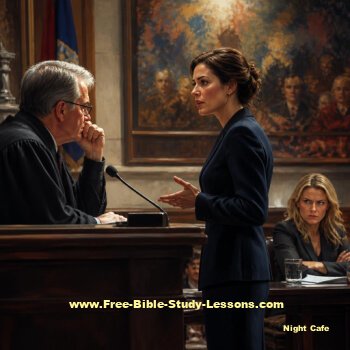
2. The second reason is to restore Godly order. Humanistic nations punish lawbreakers because they disturb a nation's peace. God created the universe as a seamless garment. Everything is connected somehow, whether we see it or not. Seeking Godly restitution - or as close to it as possible - is seeking to repair a tear in the fabric of life.
3. Next, seeking just punishment of the criminal is a way of loving and protecting future innocent victims. A person who has gotten away with a crime is likely to repeat [and often increase the intensity of] the crime against more and more people until finally stopped.
4. Also, requiring restitution is a kindness to the violator. This concept may seem a little strange; however, the criminal harms not only his victim but also himself. He further distorts the image of God in himself. He is under the delusion that he is the centre of the universe and can do as he pleases without consequence. This is a dangerous fantasy which will both destroy his life on earth and in eternity. If he can be brought to realize that his actions have consequences and that other people matter, then he is closer to having his own life healed and restored.
5. In some way, a person’s life has been violated, and there is nothing wrong or contrary to the principles of forgiveness and love in seeking Biblically appropriate restitution for the violation.
Do We Always Seek Justice?
If we had a perfect court system, the answer would be: yes. However, we all recognize that we live in a sin-damaged world. Man’s justice, even when ordered according to the Bible and not humanistic principles, will always be imperfect and subject to error. Plus, there are countries where it is dangerous for the victim - especially a Christian victim - to seek justice, as the legal system is against them to begin with. So there are times when we simply have to recognize that we will not get fair treatment on earth and rest in the knowledge that God will see perfect justice done in the end, whether in time or eternity.
Walking in forgiveness means we do not harbour bitterness against the offender or seek revenge. It also means we pray for their salvation, knowing that if they accept Jesus as Lord and Saviour, then Jesus would have paid the price for their sin… just as He has for ours. No matter what was done to us, we have hurt Jesus far more. In one way, this is a true test of forgiveness: genuinely praying for the offender's salvation and release from eternal consequences while still seeking justice and restitution on earth.

Glenn Davis is a Christian author and Bible teacher whose work draws on more than 40 years of study, writing, and teaching in local churches. He has written 700+ articles, created five Bible courses, published three books, and shared 300+ Bible videos on YouTube. Readers can find his books on Amazon, follow his teaching on YouTube or visit Glenn Davis Books. Away from the keyboard, he enjoys time with family, reading, walking, and board or card games.
Follow us on social media for daily Scripture comments and more at MeWe, Facebook or YouTube.
Sitemap -
Newsletter -
Statement Of Faith -
Donate
Sign up for our free monthly newsletter or take one of our free Bible Study courses.
Please note: We no longer have the commenting feature [maybe again in the future]. Joshua Institute students who have questions or comments on their courses can use the contact button and mention the course name and lesson number in the email. Thank you. Glenn

You might like these
Is The Law Of God Relevant Today?
God's Law is a revelatioin of His Holy Character and is as relevant today as when it was first given. Some aspedts of the law are kept in a different way, but they are still valid.
Jael: God's Assassin To Deliver His People
Jael became God's assassin and shows us some harsh principles of living in a sinful world.
Why Didn't God Give Specific Laws Against Domestic Violence?
God's Law doesn't specifically mention domestic violence. What are God's standards? What options does an abuse victim have? God sees, God cares.
God's Requirements For Capital Punishment
The Bible lays out the rules for the death penalty. God gives life and only He can declare when and how captial punishment is to be enforced.
God's Law Vs Man's Law
The conflict between God's Law Vs Man's Law is a conflict between ultimate authority: God or Man. Man has no authority to make law, only to apply God's law in specific situations.
Can The Results Of Evil Be Used For Good?
In a sinful world evil abounds. Is it ethical to use things that were evil for a good purpose?
Does The Bible Allow Public Education?
We have become so accustomed to the public education of children that we fail to search the Scriptures to see if the Bible allows it.
What Biblical Principles Are Involved Or Violated In Labour Unions?
Labour unions developed long after the Bible was written, but Biblical principles apply to every area of life. Are unions a Biblically legitimate organization?
To Be Like Jesus Is The Goal Of The Christian Life
To be like Jesus should be the cry of every Christian heart, the goal of every Christian life.
David And Bathsheba
David and Bathsheba committed adultery and David went on to commit murder, both of which were capital crimes, yet David wasn't put to death. Why not?























Privacy - Disclosure
"Feed Yourself" is a trademark of Glenn Davis. All rights reserved.
Copyright © 2004–