| site search by freefind |
- Home
- Women Of The Bible
- Rebekah
- Bride Of Christ
[If you purchase anything on this site, I may make a commission. Disclosure Policy]
The Bride Of Christ
As Seen Through Rebekah And Isaac
By Glenn Davis
The story of Abraham sending his servant to find a wife for his beloved son is a type of the Father sending the Holy Spirit through His messengers to win the bride of Christ [the Church]. [If you have not read our article on Types and Shadows, you may want to do so.] You can read the complete story in Genesis 24.
The Type
In this historical story, we see that Isaac’s dearly loved mother, Sarah, had died. Abraham then began looking for a wife for his son. He did not want a woman from among the Canaanites who were given to idol worship. So he decided to send his most trusted servant back to his home country to seek a wife for Isaac there. He placed his servant under a conditional oath and gave him rich gifts to offer the bride.
The servant, who was a Godly man, journeyed to Abraham’s home country. While waiting by the well, he asked God for a sign to show which woman was God’s choice for the promised heir, Isaac. The sign was that when the servant asked the woman for a drink, she would voluntarily offer to draw water for his 10 thirsty camels as well. Before he finished praying, a very beautiful, single Rebekah appeared, coming from the town to draw water for her family. When he approached her for a drink of water, she cheerfully offered to draw water for his camels as well. What an answer to prayer!
The servant was brought into the home where he shared his mission with Rebekah’s father and brother. After they agreed, he presented them with gifts. Rebekah agreed to accompany the servant the very next day to become the wife of Isaac - whom she had never even met or heard of before the previous day. She journeyed to Canaan and married Isaac.
Sitemap -
Free Water Of The Word Newsletter -
Statement Of Faith -
Donate
Follow us on social media for daily Scripture comments and more at MeWe, Facebook or YouTube.

The Antitype
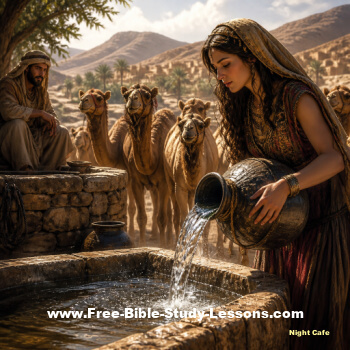
How is this story a type of the Father’s getting the bride of Christ for His Son? As mentioned in the linked article above, a type gives us a general picture [a shadow] to help us understand a New Testament concept/teaching, but it does not have to match exactly at every point.
Abraham, as a type of the Father, is very wealthy. He deeply loves his son - his only son of promise. He will do anything he can to bless Isaac. As human beings, we can relate to how Abraham felt about his son [even if we don’t relate to his wealth!]. Any parent knows the love they feel for their children. This is a Godly example, but we'll look at it from the viewpoint of the type and the antitype.
The Father
Abraham was a wealthy man. The Father owns all of creation. Abraham loved his son and wanted the best for him. The Father loves the Son. They are in a perfect love relationship with each other and the Holy Spirit [the blessed Trinity]. Somewhere, in what we call Eternity Past, before the beginning of the world, the Father, the Son and the Holy Spirit in perfect wisdom agreed upon a plan which would involve the creation of the world and the Father giving the Son a group of people to be His forever [Eph. 1:3-5, Ps. 110:3]. The Son would have a loving relationship with this people, of which the relationship between a groom and bride is an example. Part of the plan involved the Son offering His life for His bride - also called the Church. [This is seen in type in the story of Abraham offering Isaac, not in this story.] After the Son had achieved redemption for His promised people, He returned to heaven to await the arrival of His bride. [We study this in detail in The Love Covenants.]
Abraham sent His servant to find a bride for Isaac. Then, in the next stage of the plan, the Father sent the Holy Spirit to work in the hearts of those chosen as the bride of Christ from Eternity Past. The type of Abraham’s servant can picture the Holy Spirit and/or those the Holy Spirit uses, as hearts are changed when the Word is shared and allowed to do its work. The Father did not send the Holy Spirit to people who wanted to remain “in the world” [i.e. the Canaanites], but to those who would be called out of the world [John 17:14]. This may also foreshadow the doctrine of predestination and election.
The servant asked for divine guidance in selecting a wife for Isaac. While we, as human messengers, share the Word with everyone, the Holy Spirit works in the hearts of those the Father has selected for the Son to be part of His bride. Even as Rebekah passed the test, unknown to her at the time, so not everyone who says “Lord, Lord” is part of the bride [Matt. 7:21-23]. The Lord has His tests to separate the true bride from the false bride.
The Bride Of Christ
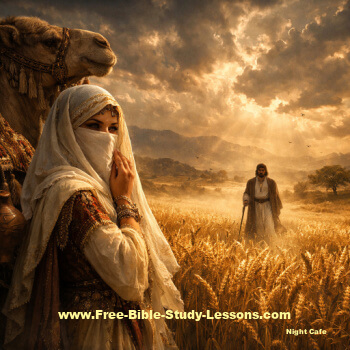
Turning now to Rebekah. She was a beautiful woman. The bride of Christ [the Church] is beautiful in Jesus' eyes. He loves her and desires her. You, as part of the bride of Christ, are beautiful and desirable to Jesus. He wants you to come into His presence. He loves being with you. Never think that He has rejected or abandoned you. He would never do that to one He loves so much.
Other than her beauty, what was there about Rebekah that pictures the bride of Christ/Church? She knew how to serve. She served willingly and cheerfully before she knew there was any reward. The Father will not give His Son a lazy, selfish bride. He wants the very best for His Son. He wants a beautiful bride who is diligent, hard-working, and generous. We are saved and kept by grace alone, but the Father has works for us to do [Eph. 2:10]. We want to be careful that we are like the wise virgins and not the foolish virgins [Matt. 25:1-13].
One principle God has built into the world is that serving well is the road to leadership. In a world polluted by sin, it does not always happen here - although, for the Christian, good, obedient service here will result in higher levels in whatever God has designed for eternity. Even here, often good service leads to rulership. Secular businesses know that the business that serves its customers best is the one that will prosper most. Rebekah served the camels and ended up riding on them to meet her husband.
As the Church learns that true service - not theological debates, legalism or superior attitudes - leads to leadership, she will begin to take genuine leadership roles. The world will change, and those inside and outside the Church will benefit in this life. The Father is not going to send the bride to His Son if she is a defeated and depressed woman or simply a “trophy” wife. He wants the Church to become a genuine Proverbs 31 woman before she meets her groom. How close do you think we are? [And men, in this type, you have to identify as the bride, not the groom!]
The Son
Isaac undoubtedly knew what his father had done. He walked and meditated where he could watch for the returning caravan. He did not know how long it would take. He probably expected it to take much longer, as the servant searched for the perfect bride. Imagine the joy and excitement in his heart as he saw that caravan crest a distant hill and weave its way toward him.
We look forward to the Final State [when Jesus returns], but that is only half the story. Jesus anticipates the time when we will all be together and the final and unending chapter can begin. He looks forward with excitement and joy, knowing the Father has chosen the best for Him.

Glenn Davis is a Christian author and Bible teacher whose work draws on more than 40 years of study, writing, and teaching in local churches. He has written 700+ articles, created five Bible courses, published three books, and shared 300+ Bible videos on YouTube. Readers can find his books on Amazon, follow his teaching on YouTube or visit Glenn Davis Books. Away from the keyboard, he enjoys time with family, reading, walking, and board or card games.
Follow us on social media for daily Scripture comments and more at MeWe, Facebook or YouTube.
Sitemap -
Newsletter -
Statement Of Faith -
Donate
Sign up for our free monthly newsletter or take one of our free Bible Study courses.
Please note: We no longer have the commenting feature [maybe again in the future]. Joshua Institute students who have questions or comments on their courses can use the contact button and mention the course name and lesson number in the email. Thank you. Glenn

You might like these
Sarah: Woman Of Faith
Sarah was a woman who knew much sorrow and disappointment, but also much joy as she was to become the mother of many nations.
Eve Misunderstood The Timing Of God's Promise
Eve misunderstood promises from God. Do we make the same mistake?
Hannah: A Woman Who Knew Pain And Joy
The story of Hannah is one of prayer, faith and trust from which we can all learn.
Helping Enemies
A little - often over-looked - slave girl has a lot to teach us about helping enemies. Instead of raging anger and bitterness she showed compassion and kindness.
Incredible Women Of Faith In History
Who were some great women of faith? From ancient to modern history they stand out as shining examples in their love for God.
Who Was Mary Mother Of Jesus?
What does the Bible reveal to us about Mary mother of Jesus and what lessons can we learn from her life?
Jesus Called A Woman Of Faith A Daughter Of God
This woman touched Jesus in faith and, in spite of her fears, discovered she was a daughter of God. True faith brings us into the family of God.
What Gift Does God Value Most From Us?
There was one gift that Jesus commented on and value which shocked His disciples. God doesn't look at things the way we do and we need to learn His prespective
Jael: Taking A Stand For God
The story of Jael, God's female assassin, who risked her life to help the people of God.
Mary, Child Of Grace
Mary did not earn her position as the mother of the Messiah. She was a child of grace, like all God's children.





Privacy - Disclosure
"Feed Yourself" is a trademark of Glenn Davis. All rights reserved.
Copyright © 2004–